I saw talk of Hans Rosling on TED a while back, but it seems his presentation of statistical data has gotten even better…
Pretty Neat – Statistics Can Be Interesting
Leave a reply

I saw talk of Hans Rosling on TED a while back, but it seems his presentation of statistical data has gotten even better…
I am sometimes torn between my scientific and spiritual side. Educated in the sciences I appreciate cold pure logic. So, when I run into a lecture likes this by Peter Boghossian…
…I might have my spiritual world shaken up.
When Dr. Boghossian explains that faith-based processes are not reliable, I have to admit that he is right. When he shows us that homeopathy does not work, I am tempted to laugh with him about the ridiculousness of faith in a remedy that does not contain anything (but water). According to homeopaths, the remedy does contain the ‘essence’ of the substance. But ‘essence’ is not something than can be measured, so it really IS only water.
 What do I do to get back to my spiritual base?
First of all I have to allow myself to be exposed to ridicule for believing in something that science can’t see. But then I also have to make real to me that there was a time, not very long ago, at that, when we could not measure radioactivity. If somebody at that time postulated something that could kill you within the shortest time without being felt, smelled, or seen, this person would have been certainly ridiculed. I make it clear to me that we cannot measure the ‘essence’ of a substance – yet!
Beyond that argument I try to wrap my mind around the question if we are possibly only looking into a self-fulfilling closed system. Results of religious believes are often explained as self-fulfilling situations – if I believe in the resurrection of Jesus with all my heart and don’t allow any other possibility, I might actually have an apparition that is as real as the cop handing out a ticket for kneeling in the middle of the street.
If this works for a single person, then a group of people can certainly increase the effect and we have those events where blind start seeing and lames start walking. Science has looked at those events with double-blind studies and found that they are all humbug. Yet, they cannot duplicate a parameter they are completely unaware off, so the double blind study might miss essential parameters.
Thus I clarify for myself that science itself is in no way different than the faith they investigate. It is just a different faith – a faith that requires a multitude of observers that all observe the same.
Comparing this with a vivid dream might make this more obvious. Imagine a dream in which you can fly. And also make this a dream where you have a sweetheart that can fly with you (yes, I am thinking of Douglas Adams.) Then add another element that there is a big crowd that cheers you on as you swoop through double barrels and looks deeply embraced with your sweetheart. Would any member in this dream doubt that you two fly?
But, but, but … that’s a dream, that is different!
To which I have to answer: Says who?
Just as I could imagine that in my dream I introduce a scientist that does not believe and demands double-blind studies, so can I imagine that in ‘real life’ I introduced those scientists that tell me that homeopathy is humbug and that they have proven it beyond any reasonable doubt.
For me it boils down to the question if the ‘real life’ is any more real than my dream. And I have to admit total inability to answer that question. Simply from the fact that while I am in the middle of my lucid dream I don’t know that I am dreaming.
Maybe I am dreaming now – I would not be able to tell until I wake up – until then the question has to remain unanswered.
Up to that point any logic is self-contained logic, conclusive within itself, and the logic of science has no more relevance than the logic of astrology or reading tea-leaves. I might have preferences, but that is solely my own, personal decision.
 I used degrading eye-sight as an excuse to replace my 24 inch monitor with a 32″ TV – and I love it. Now, when I am at the other office with only a 24″ monitor I sometimes have to put reading glasses on to see the smaller part of the photoshop interface.
The idea that, as we get older, our eyes get weaker and we accept to use glasses. There seem to be a strong correlation between the eyes and seeing.
But I have been suspicious for a while that this is not the whole story. Simply because sometimes – and I have not found the pattern – my vision is just perfect. And if it would be weaker eye muscles and less elastic lenses would be the only reason for declining eye-sight, then this would not make sense.
The following video of a painter, born without eyes (!), gives more fuel to that line of reasoning. Now, what really is seeing?
I certainly gotta get me one of those:
but I want that to be combined with the Moller car – oh no, wait – I want one with an integrated anti-gravity generator, so that we finally get where I sure thought would be at my current age when I started to read science fiction.
I ran into this video teaching us how to use a dial telephone…
… and that got me to think.
From today’s point of view, this is obviously funny; but I tried to imagine what things that we consider high-tech today will look really funny to my son when he is my age.
Speaking of my son – I have noticed one piece of technology that I grew up which he already has no personal experience with: the tick-tock of a clock. He might still know that a clock in the distant past did make such sounds but he has never heard that himself.
Or the first super-high-tech wrist watch I had – with red LED segmented numbers. These LEDs used so much power that I switch had to be pressed to turn then on – and off right away – to see the time. Very inconvenient at a party where you were fondling a glass of whiskey on the rocks trying to look as cool as your watch. Very uncool to put the glass down to be able to push the little button on your other wrist to realize that after two hours of looking cool you still did not have the nerve to talk to the cute brunette.
So, what’s the item with the biggest cool factor today? Maybe tablets like the iPad. I believe this is a good candidate to look ridiculous in 20 or 30 years. Imagine you lugging around a book sized slate – just like Moses did when he came down the mountain – just to access some information, or look up an address, while today (tomorrow) you just say your search term into the ether and the information materializes right in front of your eyes, or even better, you just pose the question in your mind and the answer is directly delivered to your own synapses via a synaptic interface – – who needs eyes – – maybe we have them closed at all times as all the experiences we have are virtual anyway. While we experience a rich virtual world our bodies are securely stored and fed through some tubes while at the same time acting as a power source for the computer system that runs the whole virtual world, and …. hold on, doesn’t that sound somehow familiar?
I went to college in Germany (there called Universität) and the semester fees were about 23 Marks – maybe 10 Dollars. I lived with my parents but was registered at a friends house so that I could draw state funded study support, part of which was a loan. (I still owe some of that today, by the way.)
So, I have to say, my college education was pretty – – inexpensive. At least for me personally, maybe not so for the rest of the population. But my justification was always that later in my professional life I will earn well and pay lots of taxes.
OK, the latter did not really happen. First, I was self employed most of the time and I first saw my money in my account and then had to write a check (instead of it being collected before the wage earner even sees it), and that created a rather intense resistance, so I did everything possible to avoid writing big numbers on those checks.
And second, I left Germany after just about six or seven years.
At one point it becomes acute to think about those things for my son. He is still a few years away from any college thoughts, but eventually it will be something to consider.
Now I ran into this video that paints a bleak picture of the current college situation here in the old US of A…
There is not that much to add in terms of the facts, that it really does not seem to be worth to go to college any more, but what I do want to add is the following from my very own experiences.
I studied physics and got up to the equivalent of a masters degree – 6 years. It was fun to a bigger degree, especially my little stints down at CERN, to mingle with world class scientists – for example the internet was born down there (no, it was not Al Gore!)
But I did not go into a career in science, but moved into the computer field which was just then starting to be something to be reckoned with. What later became computer science was, in the beginning, manned by physicists and mathematicians.
So, after college I never did anything much of physics. I did practice forcing my will onto computers during my college days, but this was more or less a side effect because the experiments I conducted produced lots of data and we happened to have PDP 11 at the physics chair where I did my work. My first contacts with computers, a little bit before that, I had in my spare time when I taught myself to program a big IBM mainframe (I think it was an IBM 360) through the use of punch cards. I did this just because I was fascinated by these machines not because of any career goal.
All this happened during a time when in most cases you could still do the job you trained for, for the rest of your life. With the accelerated development in technology and science that is definitely not true any more. Sure, programming the PDP 11 in assembler gave me some basis but certainly did not prepare me for optimizing web sites and writing that occasional php application. All what I do now is self-taught and did not require me to sit in some auditorium and listen to a professor who has given the same lecture for the last 20 year, who can not be replaces by something younger and more up-to-date because he has tenure.
This is why I have to wholeheartedly agree with the implied conclusions in the above video that going to college at this time is a waste of time and money, and at these costs would just make you a slave for the rest of your life. It was scary for me to learn that not even a bankruptcy can get you out of these student loans – do I see debtor’s prisons on the horizon?
Maybe my son is really smart that at his young age he is really embracing the digital world, because that might be the area that we will be living in in 10 – 15 years. You better learn how to become an entrepreneur in Second Life.
Many, many – – many – years ago I had a little friend, three actually. When I met the three nephews/nieces if my best buddy they were three/four/five years old. Harald, the middle one came out to the garden where my buddy and I were drinking beer to check out that new dude. One of the first test he conducted was “how does he react to pinching?” My reaction – “pinching back” – must have been the correct one because we became really good friends and grew up together until I finally had to leave the country (but that is a whole different story.)
One of the stories with Harald I remember was that he came up with the idea of washing my car. It was another beer-drinking session in the garden, a few grown-ups doing all the work and several kids playing in the garden as well – not drinking beer!
This is when Harald had the idea “Can I wash your car?” Generous as I was – and knowing that the car could really use that treatment – I said “Sure!” There was quite some commotion about finding a hose, sponges and other things that I did not know you needed to wash a car and an hour later my car was clean(er), and Harald was very proud about his job well done.
Several of the beer-drinking, session-attending adults now suggested that I should pay Harald something for his work. But even at that young age I was too smart for my own good and realized that this would not be a good thing. So, I politely declined to follow those recommendations and instead demonstrated Harald how much I appreciated his deed by becoming an even better friend.
Sometimes it takes the universe a long time to acknowledge the correctness of ones actions, and for this event I finally found the acknowledgment after so many years in form of a TED talk that I just have to share here.
Here we go – enjoy!
There are always two sides to a coin, and today I had to reflect on these two side in regards my my anarchistic conviction.
It is easy and righteous to be an anarchist, and to help as little as possible for all those things most of us abhor. War, extortion, corruption, etc. But there are a few things that I like that these guys are doing, like helping to get pictures like this…
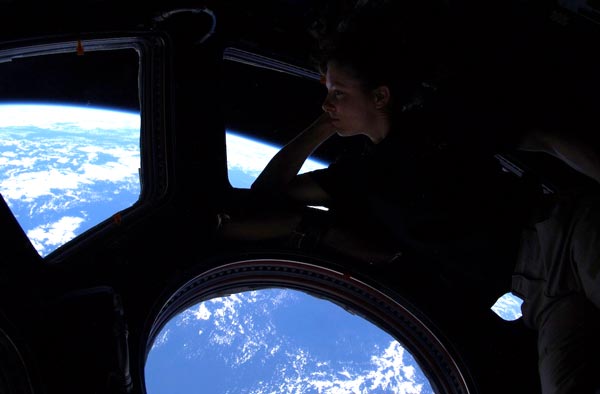
Tracy's View out of the Cupola on the ISS
This is just one sample of the pictures taken by astronaut Douglas H. Wheelock during his stay at the International Space Station just about 200 miles straight up. I can’t help considering other people who do not appreciate this venture out into space, just as I don’t appreciate beating up the Irakies or toppling a South American Dictator.
One of the most heard arguments against anarchy (in the sense of a society without a ruling government – not the definition of ‘chaos in the streets’) is “but somebody will have to build and maintain the roads!” On first glance that seems to be a valid argument, but thinking a bit further there are possibilities that don’t make it look so good. For one, a private builder who builds an area with houses he wants to sell, will make sure that there is a road that lets people get to these houses. Would make the houses probably a bit more expensive but considering that the buyer does not pay any taxes to a usually very inefficient government, the house with the street factored in would probably come cheaper than the house plus the taxes.
But what about highways and freeways? In part of the US we already have toll roads and they seem to be working just fine, and again the saving in taxes factored in, traveling might actually become cheaper. But lets assume that it would actually be more expensive to travel longer distances along toll roads – maybe other means of transportation would have been invented if they would be now more competitive without any government strong-arming the use of the road and car system. Maybe there would be already flying cars that don’t require expensive road building – or we would actually have the rolling roads of the early Heinlein – would THAT be cool!
Back to the space pictures. It might have take us a bit longer to reach the moon, but there is a good chance that we would have a flourishing space industry if there would have been no monopolistic government involved. A good chance that I might be able to afford a trip to Bigelow’s Space Hotel in one of Burt Rutan’s SpaceShip 4’s.
There would have been less people contributing to the cost of developing these space technologies, because right now each and every tax-paying citizen is a contributor. But if only the people who wanted it would be contributing, which is far less, it still could be more, as – first – an inefficient middle man is cut out of the loop, and – second – the people who do contribute really want it, and how much energy does does real intention add to the equation?
But despite all these ifs and whens I can still enjoy the great images from the ISS that were created with all our contributions – willing and unwilling – even forced. Here again the link to astronaut Wheelock’s images.
I learned it when I studied the Kabbalah, but many other philosophies say the same, that we are not presented with a problem, if there is not also a solution available – for us to find and use. I know this logic has a bit of a hole, as nobody who was presented with a problem for which there was no remedy is around any more to tell about it, but I like the first point of view better, so I take that.
The problem I am thinking of now, is the swine flu. Today, Ed (thanks Ed!) sent an e-mail presenting the solution for that problem. I know there is, or shortly will be, a pharmaceutical, and expensive, solution, but I always want to look at natural remedies first, in order not to get from the fire into the frying pan – fire being a deadly threat to the world and frying pan being dependency on the pharma-industry.
Science Daily has the following article:
Scientists in China have discovered that roots of a plant used a century ago during the great Spanish influenza pandemic contains substances with powerful effects in laboratory experiments in killing the H1N1 swine flu virus that now threatens the world. The plant has a pleasant onion-like taste when cooked, but when raw it has sap so foul-smelling that some call it the “Dung of the Devil” plant.
Kindly, Ed also supplied some more info about this plant in a Wikipedia article about ‘Dung of the Devil’ and he even passed on a source to buy Asafetida.
Now you have a solution for the time when the friendly government agent comes and wants to give you the mandatory swine flue vaccination – if you have a sample of asafetida in your pocket and let him smell, he will run and look for more gullible victims to thrust his benevolence upon.
With that sample of asafetida you might not have any friends, but let’s make that the subject of another article.
We are proud today to be able to offer you instand religious enlightenment.
Sounds pompous?
OK, I admit, it’s a bit far fetched, but isn’t seeing an apparition often the start of a religion? Isn’t the perception of something not belonging to this world is a clean sign that that there are things beyond what we perceive?
Real work is done in this department and over there at Universal Serenity it’s now started for sure, but for the instant gratification society here in the US we have a goody.
See this image below. It has four little dots in the center – this is where the universe will break apart, so start at these points for maybe half a minute…

Done?
Now look at a blank wall, see a circle of light appear first, and then ….
(This one found amongst other amazing phenomena at GeZi World.)